Pickleball doubles mixer with rotating partners
Players sign up alone, get a new partner every round, and the sit-outs are shared evenly. The perfect format for socials and mixed groups.
Why run a mixer
Fixed teams are great when people come with a partner. A mixer is better when they don't: everyone meets everyone, new players aren't stuck with one partner all night, and the evening feels social rather than competitive. It's also the easiest format to fill — one sign-up per person, no pairing headaches.
How PickleIn builds the rounds
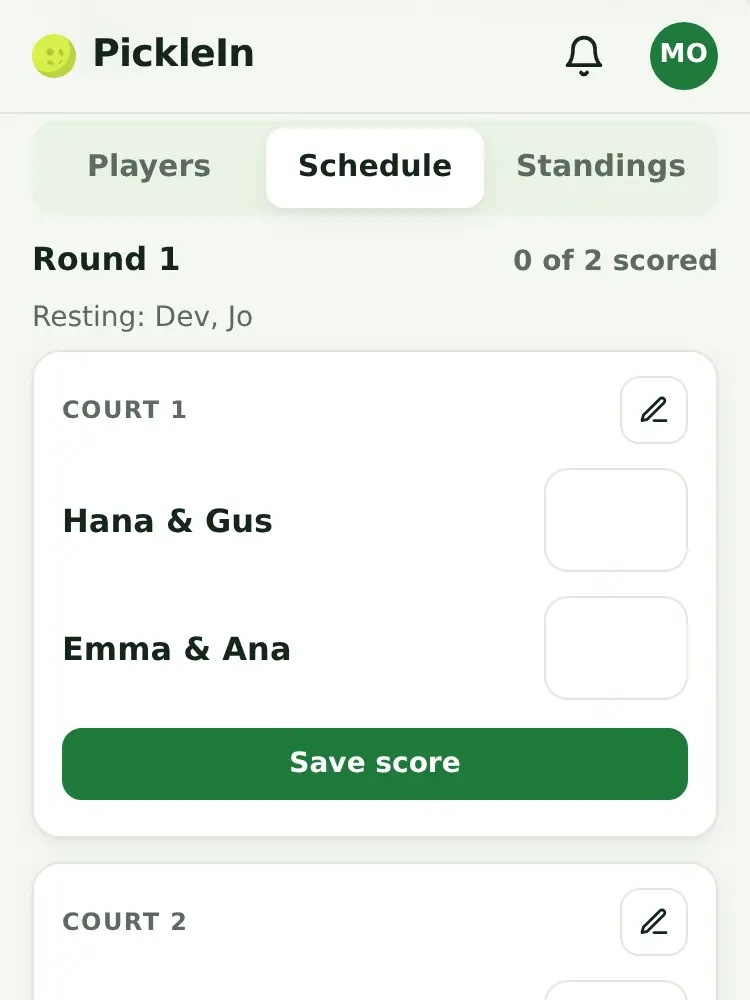
Each round, PickleIn picks pairings that avoid repeat partners and repeat opponents as long as it can, and rotates who sits out. With 8 players on 2 courts nobody sits out; with 10 players on 2 courts, two rest each round and everyone rests the same number of times (give or take one).
- 8 players, 2 courts, 4 rounds: everyone plays 4 games.
- 12 players, 3 courts, 4 rounds: everyone plays 4 games.
- 16 players, 3 courts, 4 rounds: everyone plays 3 games, 4 sit out per round.
On the day
Late arrival before you start? Add a walk-in. Someone can't finish? Swap a player into their spot or mark a game "didn't play". Scores go in from any phone and the individual standings update for everyone.
Not sure which format to pick? Read mixer vs fixed partners.
Free. Sign in with your email — no password, no app to install.
FAQ
What is a pickleball doubles mixer?
A social format where players sign up alone and get a new doubles partner every round, playing against different opponents each time. At the end, standings are individual.
How many rounds should a mixer have?
PickleIn suggests players − 1 rounds, capped at 4, which fits about an hour of games to 11 — add rounds for a longer session. You can pick any number, and it tells you up front how many games each person gets.
What if the numbers don't divide into courts?
Some players sit out each round. PickleIn shares the sit-outs as evenly as possible, so nobody sits twice while someone else never does.
How are mixer standings ranked?
By each player's wins, then point differential, then points scored — partners change every round, so it's an individual table.
Do players need an account?
To join from the link, players sign in with their email (a one-time link — no password). The organiser can also add walk-ins by name.